Understanding Loi 27. And above all, what to do.
· Updated on June 18, 2025
The most significant overhaul of occupational health and safety in forty years is now in force. Here are the essentials, jargon-free, and above all what to do this very week.
Loi 27 modernizes Quebec's occupational health and safety framework and, for the first time, puts psychological health on the same footing as physical health. Since October 6, 2025, every organization must assess, document and prevent psychosocial risks such as chronic stress, work overload or harassment.
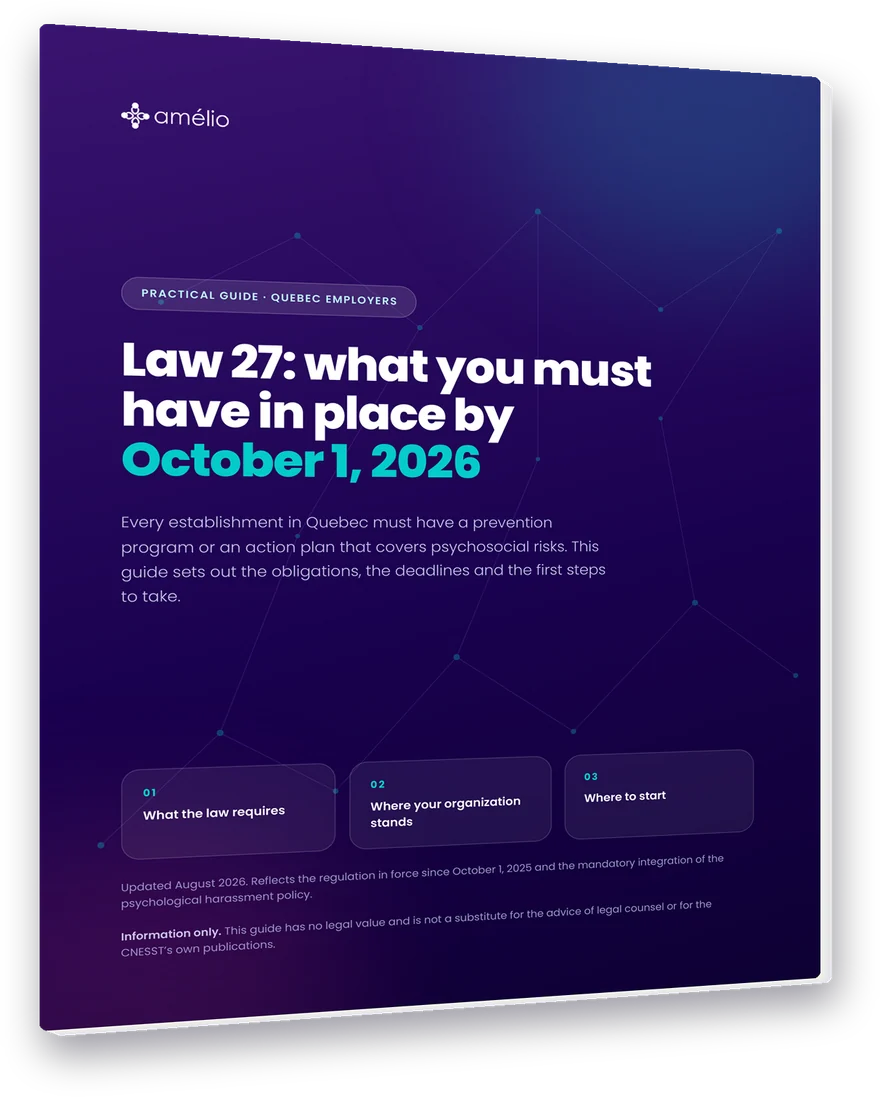
Law 27: what you must have in place by October 1, 2026
Every establishment in Quebec must have a prevention program or an action plan that covers psychosocial risks. This guide sets out the obligations, the deadlines and the first steps to take.
- 01What the law requires
- 02Where your organization stands
- 03Where to start
PDF · Updated August 2026, including the regulation in force since October 1, 2025.

Loi 27 did not come out of nowhere. It stems from Bill 59, which set out to reconcile physical and psychological health at work. Passed in October 2021, it rolled out its obligations in stages, up to the key deadline of October 6, 2025.
For forty years, prevention was imagined in steel-toed boots and guardrails. Loi 27 broadens the definition: health at work now includes the mind, not just the body.
The body, mostly
Prevention focused on physical risks.
Psychological health left to goodwill.
Often reactive and poorly documented.
The body and the mind
Psychosocial risks on the same footing as physical risks.
Mandatory, ongoing assessment.
Documented traceability and formalized employee participation.
Everyone. The law applies to every Quebec workplace, without exception. What varies is the mechanisms required, based on the number of people at the establishment.
Establishments of 19 people or fewer
A health and safety liaison officer, and a written action plan that incorporates psychosocial risks.
Establishments of 20 people or more
A joint health and safety committee and a designated representative, plus a structured prevention program that includes psychosocial risks and awareness measures.
Why psychosocial risks go unnoticed
You can tell with the naked eye whether a tooth is healthy. But a hidden cavity takes an X-ray.
Psychosocial risks are just the same: rarely visible on the surface, very real underneath. A disengaged employee, for that matter, rarely becomes one overnight. The law asks you to look beneath the surface. Here is what it recognizes:
- Excessive workload
- Lack of recognition
- Unclear roles
- Strained relationships
- Harassment
- Isolation
- Loss of meaning
- Job insecurity
A one-off survey is a photo taken on a Tuesday at 10 a.m. What really matters is the film: what happens between measurements.
A disengaged employee who stays often costs you more than one who leaves. Workplace climate does not show up on a financial statement, but it weighs on productivity, service and retention.
No need to do everything at once. Three moves are enough to start off right and stay the course.
Diagnose
Assess psychosocial risks methodically: a structured, validated survey, internal indicators such as absenteeism and turnover, candid conversations. Not impressions.
Document
Record your findings in a prevention program or a written action plan, with objectives, owners and deadlines. This paper trail becomes your protection in the event of a CNESST inspection.
Keep it alive
Train your managers, track your indicators and adjust continuously. Compliance is not a document gathering dust in a drawer, it is a habit.
Amélio is the organizational intelligence system for companies. For Loi 27, that translates into three concrete things, which map exactly onto your three obligations.
A scientific survey, built on the JD-R model (12 factors, 40 sub-factors), together with comment analysis, reveals your real psychosocial risks, by team and by at-risk group.
In any organization, two or three levers genuinely tip the climate; the rest is noise. Amélio finds those levers, through importance-based prioritization and proprietary sector benchmarks.
Automated action plans, year-over-year comparisons and real organizational development experts to support you over time.
Your HR team is not there to run surveys. It is there to transform the organization. Amélio gives them back the time to do it.
Amélio helped us structure our engagement initiative and turn data into concrete levers for action.
What is Loi 27, in a nutshell?+
It is the Quebec law that modernizes occupational health and safety and officially recognizes psychosocial risks. Since October 6, 2025, preventing them has been mandatory for all employers.
Which psychosocial risks must be assessed?+
Notably work overload, lack of recognition or role clarity, strained relationships, psychological or sexual harassment, isolation and job insecurity.
Is a health and safety committee mandatory?+
Yes, for establishments of 20 people or more. Below that, you designate a liaison officer and maintain a written action plan.
What are the risks of non-compliance?+
The CNESST can step in, require corrective measures and impose financial penalties. Documenting your process remains your best protection.
Is it complicated to put in place?+
Not if you proceed in stages: a structured diagnosis, a written plan, then ongoing follow-up. The right tool and proper support cut the effort considerably.
Free guide
Take the Law 27 guide with you
What the law requires, where your organization stands and where to start: 14 pages to get ready for the October 1, 2026 deadline.
Download the guide →Loi 27 is not just one more constraint. It is a reason to finally see what is holding your teams back, and to act where it truly counts.
Not a survey. Not a report. A transformation that lasts. Assess your psychosocial risks