
Vosker
When managers are stretched thin, evaluations get rushed. Employees are assessed on just a few weeks, and not the same way from one team to the next. Amélio changes that: the year-end evaluation is built all year long, so you see each person's performance clearly and truly grow their skills.
No plan. Never addressed.
Every year, we go through the motions: we evaluate, assign a rating, and then hope real change will follow… The employee gets their review, files the form away, and nothing really changes in their work. We judged, we didn't help anyone grow.
That's the real waste: so much energy spent rating people,
so little spent developing their skills.
The manager is short on time, the team's context never makes it into the evaluation, and the same person isn't judged the same way from one team to the next. In the end, the employee doesn't grow as fast as they should.
Every evaluation starts from a skills profile tailored to the person's role and ambitions. Rather than a vague overall score, Amélio shows, skill by skill, where each person stands: what's mastered, what's progressing and what's still to develop.
And it doesn't stop at the diagnosis. Amélio names precisely the skills to work on to reach the next level, turning the evaluation into a real development plan, clear for the employee and the manager alike.
Whether you evaluate once a year or continuously, Amélio adapts. The real difference is that the year-end evaluation no longer starts from scratch. It builds over the months, through small check-ins where you talk about the skills to work on and help the person move forward.
By the end of the year, all that work has already painted a complete and fair picture. The employee gets no surprise: they recognize themselves, they feel they belong and that they've genuinely grown. And the manager has lightened their mental load and finally buys into the process.
Amélio prepares the discussion documents for the manager, so the performance meeting becomes effortless. They walk in with everything in hand to talk it through with their employee and align on the few points that truly matter to them.
We even generate a meeting plan based on the employee's evaluation.
A single viewpoint has a blind spot. The manager, colleagues, the person themselves: each lights up one facet, and the picture becomes complete instead of one-sided.
For every question, Amélio has already gathered and summarized it all: what the team is experiencing, the ratings, the 360 feedback, the self-evaluations. The manager no longer has to dig around everywhere; they have the full picture in front of them and their evaluation comes together far faster.
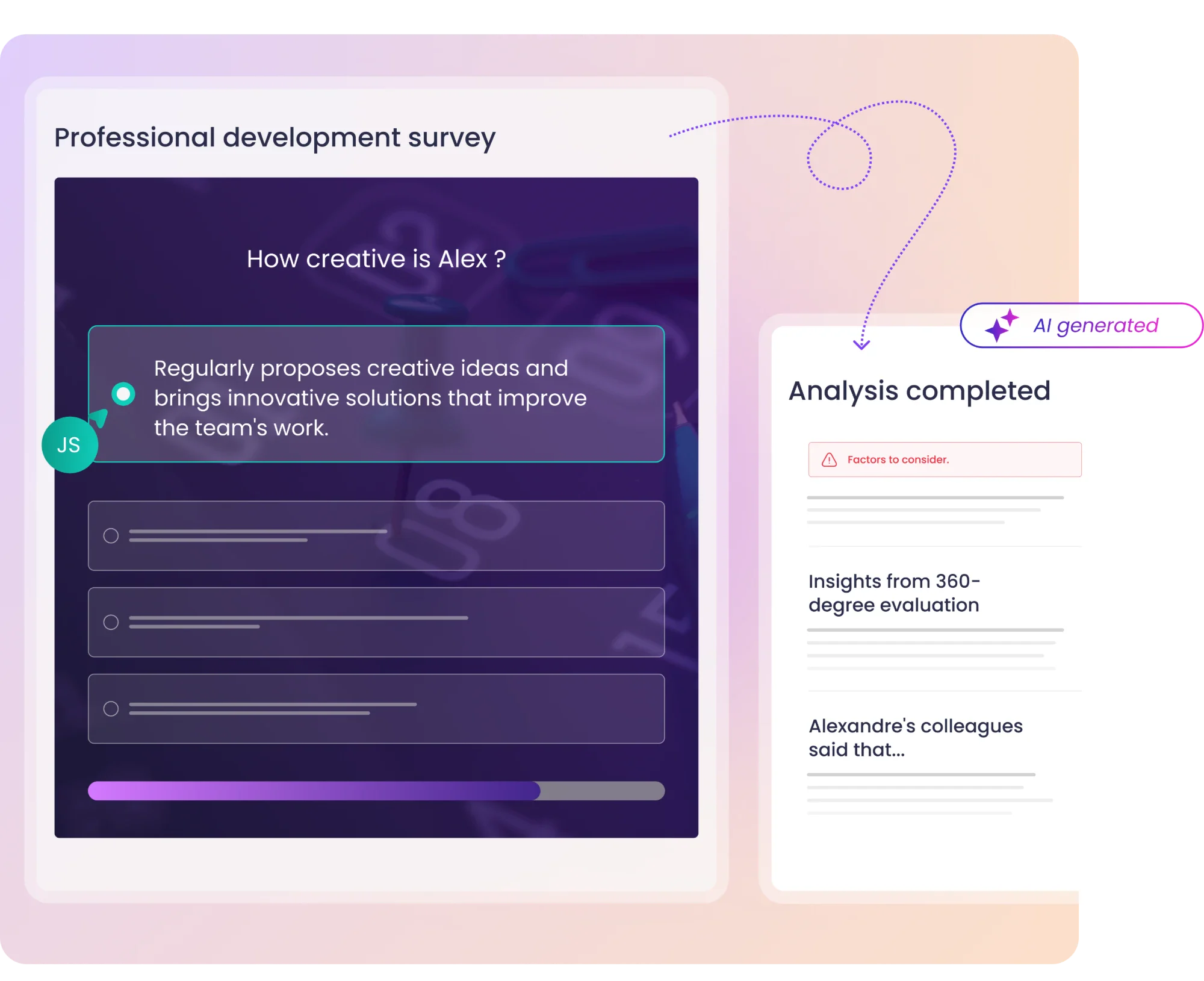
Sometimes what causes someone to disengage doesn't come from them, but from their team. Not always, and that's exactly what you need to be able to untangle. Amélio places the team's signals right next to the person's picture, to tell a real performance issue from an atmosphere problem, and act in the right place.
Changing teams shouldn't change your rating. Amélio gives every manager the same framework and situational questions, so that the same work is seen the same way, no matter who holds the pen. Fairness is no longer wishful thinking; it's built into the method.
The same contribution, judged the same way, no matter who holds the pen.
When the rating decides pay, the real development conversation shuts down. With Amélio, skill development is discussed all year long, never tied to payroll. And because everyone tracks their progress over the months, the pay moment is no longer a surprise: the employee already knows where they stand and what's coming.
Every evaluation starts from a skills profile. For each skill to look at, Amélio doesn't ask the manager to write a rating. It shows them a few concrete situations, described in plain words, and asks a single question: which one is most like your employee? The manager recognizes a behavior they've already seen, picks it, and it's done.
By describing real behaviors rather than the skill itself, we build the evaluation from what actually happens. And because everyone starts from the same situations, two managers looking at the same person reach the same conclusion: we're talking about observed facts, described simply, not impressions or long debates.
Why do it this way
We start from real behaviors everyone recognizes. That's why the evaluation becomes fair, fast and useful.
The same person read the same way, no matter who evaluates them.
A few seconds instead of a paragraph. The blank page disappears.
An observed behavior, not an abstract label.
At several points in the year, each check-in feeds the profile.
Real situations, not a verdict handed down from above, so less sense of unfairness.
This is the heart of what sets us apart. No one else cross-references team engagement data with the manager's evaluation in real time. Where others hand out forms, Amélio supports the conversation. The result: you see each person's performance clearly and develop their skills, with the context that explains them.
Collective context informs the individual evaluation, right as it happens.
A shared framework and criteria, so the same contribution is judged the same way from one manager to the next.
A first draft and clear leads that make a rigorous evaluation possible in about forty minutes.
The development conversation happens all year long, never as a payroll verdict.
Real stories from inspiring companies transforming their engagement with Amélio.






See how Amélio gives managers a fair view of each person's performance and the time to develop their skills, all year long.