What is the eNPS or tNR? We reveal all its secrets
One question, one number, and yet one of the most telling indicators for measuring your employees' engagement. Here is everything you need to know about the eNPS.

The numbers speak for themselves: companies with highly engaged employees are 23% more profitable and 21% more productive. Engagement is therefore not an HR topic reserved for lofty speeches: it is a genuine driver of performance. The catch is that you first need to be able to measure it, simply and regularly.
That is exactly what the eNPS promises: distilling an entire organization's sense of belonging into a single question and a single number. Easy to collect and easy to track over time, it has become an essential benchmark for managers who want to know, without beating around the bush, whether their teams would recommend their company.
What you'll discover
What is the eNPS or tNR?
eNPS stands for Employee Net Promoter Score. In French, it is known as the Taux net de recommandation, or tNR. Behind that slightly technical name lies a very simple idea: measuring how many of your employees would be willing to recommend your company as an employer to the people around them.
The indicator did not appear out of nowhere. It is directly derived from the NPS, the Net Promoter Score, a tool created in the 1980s to measure customer satisfaction and loyalty. The logic is the same: a customer who warmly recommends a brand becomes its ambassador, and that spontaneous recommendation is a far more reliable signal of loyalty than a simple satisfaction rating.
The eNPS applies this same reasoning and adapts it to the employee experience. The question is no longer "would you recommend this product?" but "would you recommend your company as an employer?". The focus shifts from the customer to the person who, day after day, brings the organization to life from the inside.
How is it calculated?
The whole strength of the eNPS lies in its simplicity. It rests on a single key question, put to your employees:
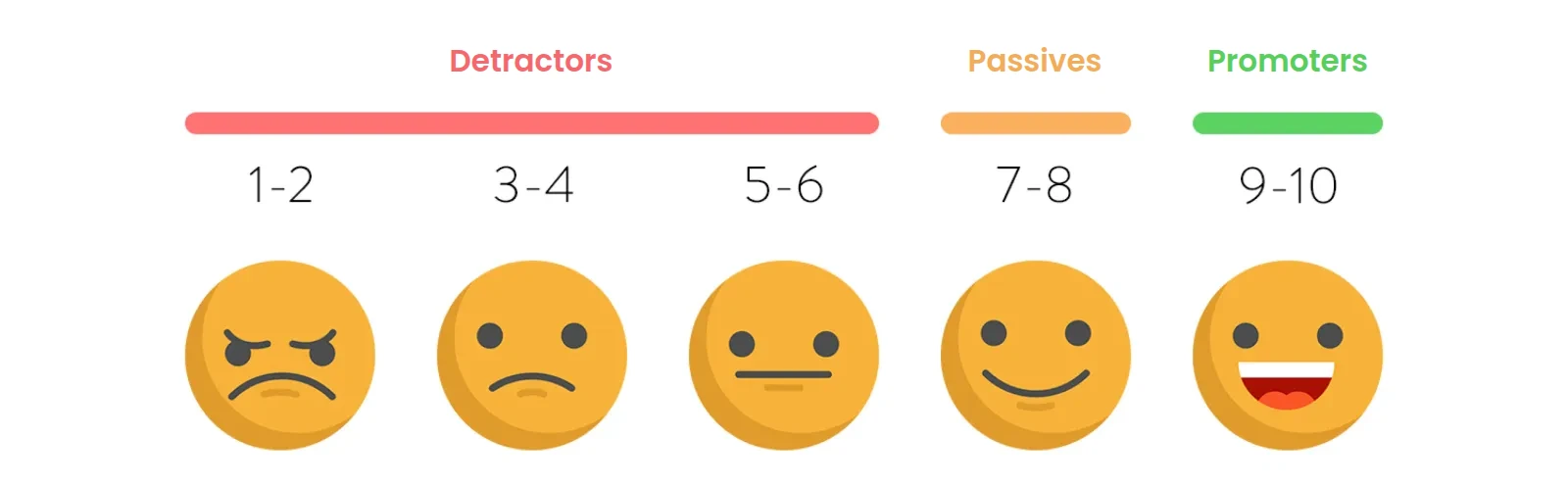
"Would you recommend your company as an employer?" Employees answer by giving a rating from 1 to 10.
Depending on the rating they give, each person falls into one of three groups. It is this breakdown that gives the indicator all its richness:
The calculation then follows a crystal-clear logic: you subtract the share of detractors from the share of promoters. Passives, for their part, are not counted directly in the formula.
eNPS = % of promoters − % of detractors
The result is expressed on a scale that runs from −100 to 100. A score of −100 would mean all your employees are detractors; a score of 100, that all of them are promoters. In real life, reality obviously sits somewhere in between, and that is precisely what makes the interpretation interesting.
What counts as a good eNPS?
This is the question everyone asks after getting their first result. The answer calls for a bit of nuance, but a few benchmarks make it easy to find your bearings quickly.
- A good score generally sits between 10 and 40.
- Above 30, you have a genuine critical mass of ambassadors within your teams.
- Above 50, your score is simply excellent and places your organization among the most admired employers.
Positive, acceptable or negative score?
A positive score is already a good sign: your promoters outnumber your detractors. A score close to zero is acceptable, but it points to a fragile balance in which every irritant weighs heavily. A negative score, on the other hand, is a genuine warning signal: your detractors outnumber your ambassadors, and the risk of disengagement, or even departures, is very real.
Beyond the score
As useful as it is, the number never tells the whole story. An eNPS of 25 in an organization that stood at 5 last year is excellent news; that same 25 in a company that used to top out at 45 should, by contrast, put you on alert. What matters most is therefore not the score in itself, but the trend over time and the action you take from it. A good eNPS is not a grade to show off: it is a starting point for understanding and for acting.
An eNPS is not a report-card grade: it is a compass. What matters is not today's number, but the direction it points you in and the steps you take next.
Why measure it?
You might think a single number cannot possibly capture the health of an organization. And yet the eNPS delivers valuable insight, for four main reasons.
- It reflects engagement and organizational health. An employee ready to recommend their company is, as a rule, an engaged employee. The eNPS therefore offers a quick, reliable read on the overall climate.
- It surfaces invisible issues. Because it is collected anonymously, it brings to light frustrations no one would dare voice in a meeting: a workload that has become unbearable, a lack of recognition, a decision that was poorly understood.
- It spots ambassadors and at-risk groups. By segmenting the responses, you identify the teams that shine and, conversely, those where disengagement is setting in and where action is most urgent.
- It shows employees that their opinion counts. Simply asking the question already sends a message: the organization cares about what its people are experiencing. Provided, of course, that you follow through.

How to improve it?
Measuring is good; making progress is better. Lifting your eNPS is not a matter of magic: it rests on two complementary levers, to be pulled in parallel.
Lever 1 · Address the irritants
The first instinct is to tackle whatever weighs on your employees. Three irritants come up at the top of the list almost every time:
- A lack of recognition, which erodes motivation faster than anything else.
- A workload that has become unbalanced or unrealistic.
- Insufficient communication, which leaves teams in the dark.
To find out which ones truly affect your teams, nothing beats a careful read of your engagement drivers. You will then know where to start, rather than acting at random.
Lever 2 · Build on your strengths
Reducing irritants is not enough: you also need to amplify what is already working. A strong culture of mutual support, managers who genuinely listen, a widely shared sense of purpose: these strengths are the soil your promoters grow in. Naming them, celebrating them and reinforcing them turns satisfied employees into true ambassadors.
And these two levers, combined, produce concrete results. CyberPublicity is a fine example: the company raised its eNPS by more than 30 points in ten months. To find out how they did it, head this way.

Frequently asked questions
What is the difference between the NPS and the eNPS?
The NPS (Net Promoter Score) measures customer loyalty: it gauges whether your customers would recommend your brand. The eNPS (Employee Net Promoter Score), also called the tNR or Taux net de recommandation, applies exactly the same logic to your employees: it measures whether they would recommend your company as an employer. It is the same tool, turned toward the inside of the organization.
What is a good eNPS score?
A good eNPS generally sits between 10 and 40. Above 30, you have a critical mass of ambassadors; above 50, your score is excellent. What matters most, however, is the trend over time: a score that is climbing is often worth more than a high number that has stalled.
How is the eNPS calculated?
You ask one question rated from 1 to 10: "Would you recommend your company as an employer?". Respondents fall into detractors (6 or below), passives (7 to 8) and promoters (9 to 10). You then apply the formula: percentage of promoters minus percentage of detractors. The result ranges from −100 to 100.
How can you improve your eNPS?
Two levers work hand in hand: addressing the irritants (recognition, workload, communication) and building on your strengths. To target the right actions, rely on your engagement drivers. The example of CyberPublicity, which gained more than 30 points in ten months, shows that rapid progress is possible.
In short
The eNPS, or tNR, is one question, one number and a wealth of insight. Inherited from the NPS designed for customers, it measures the share of your employees ready to recommend your company. A positive score is a good starting point; above 30, you have a real force of ambassadors. But the number is only worth what you do with it: by addressing the irritants and building on your strengths, progress follows.
So, what is your organization's eNPS today? Are your detractors more numerous than you think? And above all: what do you plan to do to turn your passives into promoters?
Move from measuring to acting
Measure your teams' eNPS, understand what lies behind the number and act on the right levers, with Amélio.
Book a demo