Employee engagement platform for a remote team: how to choose the right one
Your best teams now work from the kitchen table, a co-working space or another city. They show up, but you no longer see them. Choosing an engagement platform for these teams is not about the number of features. It's about what it finally lets you see.
The essentials
For a remote team, the best engagement platform isn't the one that asks the most questions. It's the one that meets three specific needs: seeing what distance hides from you, isolating the two or three levers that truly matter, and equipping your managers to act without you having to train them.
Remote work creates a paradox. Fully remote employees show the highest engagement rate, 31% versus 23% for hybrid, according to Gallup in 2025. But they are also the loneliest, 27% feel lonely every day, and the most likely to leave, 57% are looking for another job. A dashboard that only shows a good score lulls you to sleep.
When you shop around, look for five capabilities: collection that reaches everyone whatever the channel, anonymity that lifts participation, prioritization that filters out the noise, a predictive attrition signal, and recognition that rebuilds belonging at a distance. The rest is secondary.
What you'll learn
- Why remote engagement is a case of its own
- The six criteria of a good platform for distributed teams
- How to spot a departure before it happens
- The checklist to keep on hand
- The questions HR leaders ask most
Why is remote engagement a case of its own?
Because distance erases the signals you used to read without thinking. The sigh in the hallway, the meeting where someone checks out, the person who stays late for no reason. Remotely, all of that disappears. You no longer manage what you see, you manage what people choose to show you.
Gallup's numbers reveal a trap. Fully remote people are the most engaged, but also the most isolated and the most ready to leave. Measured engagement rises, loyalty falls. Two curves moving in opposite directions, and only one is visible without the right tool.
Source: Gallup, State of the Global Workplace, 2025.
That last figure is worth pausing on. A team can tick every box on a survey and quietly plan its exit. Connection to the organization's mission, among fully remote employees, had fallen to 28% in 2023, a low not seen since 2011, again according to Gallup. There's the real stake: attachment erodes exactly where no one is looking.
An employee who is engaged on paper can be an employee who has already left in their mind.
You can be together for twenty years and be completely disconnected. The absence of conflict doesn't mean everything is fine. A remote team is the same: quiet isn't proof of health, it's often the first symptom of a bond coming undone.
How do you know what's going on when you see no one?
Start with collection. A platform that only reaches email inboxes leaves frontline staff, evening shifts and teams spread across time zones in the blind spot. Look for multichannel collection, by email, text message, QR code or kiosk, so that everyone can respond, wherever they work.
The quality of the response matters as much as the channel. Without anonymity that feels genuinely real, people polish their answers, especially remotely where trust builds more slowly. Ironclad anonymity lifts participation beyond 85% from the very first survey. You get the real picture, not a reassuring version.
How do you avoid drowning in data?
By choosing a platform that filters for you. Most tools hand you thirty indicators and leave you to guess where to start. Remotely, where management time is already tight, that's a poisoned gift. You end up with a report, not a decision.
In any organization, two or three levers tip engagement. The rest is noise. A good platform isolates those two or three levers instead of putting everything on the same footing. That's the difference between measuring what matters and measuring what's easy to measure.
How do you help managers who manage remotely?
By giving them a plan, not another dashboard. The remote manager carries more: they lead without the cues of the hallway and must prompt the conversations that, elsewhere, happen on their own. A platform that abandons them in front of their numbers solves nothing.
The data is clear on who holds the key. Managers account for 70% of the variation in a team's engagement, according to Gallup in 2025, yet only 44% have received formal training. Look for a platform that equips your managers without you having to train them: an action plan generated from their team's results, the right questions to ask in one-on-ones, and actions ranked by impact.
The goal fits in one sentence. Every manager in your organization should know what to do with their team this week. Not in three months. Not in theory. This week.
A raw dashboard
- Thirty indicators on the same footing
- No order of priority
- "Figure it out yourself"
- The manager closes the tab
A prioritized action plan
- The two or three levers of their team
- Actions ranked by impact
- The right questions to ask in one-on-ones
- The manager knows what to do this week
How do you spot a departure before it happens?
With a predictive signal, not an exit survey. When 57% of your remote employees are looking elsewhere, learning their decision on the day they resign comes a quarter too late. The platform has to catch disengagement while it's still reversible.
Look for a predictive attrition indicator that cross-references signals over time and surfaces at-risk people before they tip over. That's where the most insidious cost hides: a disengaged employee who stays often costs you more than one who leaves, because they hold the role without carrying it. A good platform sees both.
How do you rebuild a sense of belonging at a distance?
By making visible what distance makes invisible: everyone's contribution. Loneliness at 27% isn't a mood problem, it's a connection problem. A distributed team's wins go unnoticed, for lack of a hallway to highlight them. Recognition fills that void, provided it's structured, not left to chance.
Look for peer-to-peer recognition where anyone can name a colleague, where quiet contributions become visible to the whole team, and where life-cycle moments, onboarding, anniversaries, departures, are marked even hundreds of kilometres apart. Feeling appreciated remains the number one reason for happiness at work. Remotely, it's also the first thread still connecting you to your people.
We've seen a huge difference in our staff retention since rolling out the recognition component.Solène Hobléa, Client Experience Director, CyberPublicity · eNPS up from 6 to 39 in 10 months; the share of employees wanting to stay more than two years rose from 47% to over 70%.
How do you keep the effort alive over time?
By refusing the tool you install and then forget. An annual survey, remotely, is a postcard once a year. What changes things is what happens between surveys. The platform has to support a continuous rhythm, not an event.
Two things make the difference over time. Year-over-year comparisons and industry benchmarks, drawn from a large pool of organizations, to place your results instead of reading them in a vacuum. And human support from people who know your reality, so the effort doesn't rest on your HR team's shoulders alone.
- Multichannel collection that reaches the field as well as the office
- Real anonymity and participation above 85%
- Prioritization of the two or three levers that matter
- An action plan ready for every manager
- A predictive attrition indicator
- Structured peer-to-peer recognition
- Industry benchmarks and human support over time
What Amélio was built to do
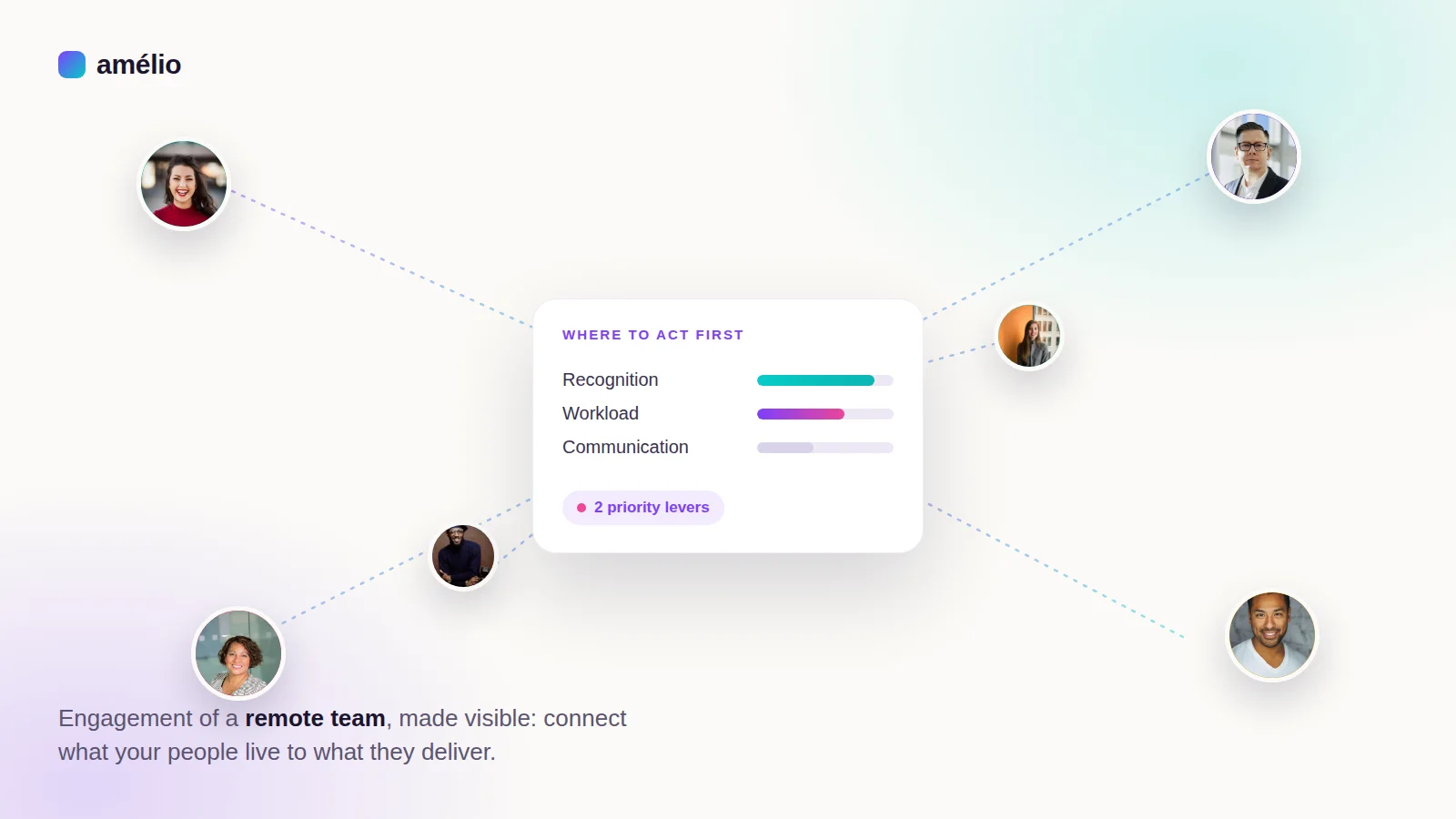
These seven criteria describe, one by one, what Amélio was built to do. Amélio isn't one more survey tool. It's an organizational intelligence system that links what your remote team experiences to what it delivers, then shows you where to act first.
Reach everyone
By email, text message, QR code or kiosk, from the office to the field.
The real picture
Ironclad anonymity that lifts participation beyond 85%.
The right levers
Prioritization isolates the two or three levers that move your results.
A plan per manager
Every manager knows what to do with their team this week.
See departures coming
A predictive indicator flags at-risk people while it's still reversible.
Rebuild belonging
Peer-to-peer recognition connects teams that distance keeps apart.
All of it backed by benchmarks drawn from more than 750 organizations and by support from organizational development advisors.
Your HR team isn't there to run surveys. They're there to transform the organization. Amélio gives them back the time to do it.
Frequently asked questions
What is the best engagement platform for a remote team?
The best platform is the one that meets three needs: seeing what distance hides from you, prioritizing the right levers and equipping your managers. For a distributed team, favour multichannel collection, real anonymity, prioritization by importance and a predictive attrition signal, rather than a long catalogue of features.
Are remote employees less engaged than others?
No, often the opposite. According to Gallup in 2025, fully remote employees show the highest engagement rate, at 31%. The real risk is elsewhere: they are also the loneliest, at 27% every day, and the most inclined to look for another job, at 57%. A good score alone isn't enough to conclude that all is well.
Is an annual survey enough for a distributed team?
Rarely. An annual survey takes a snapshot, whereas remote engagement plays out in what happens between surveys. A platform that supports a continuous rhythm, with an action plan for managers and peer-to-peer recognition, works where the annual snapshot leaves a blind spot.
How do you measure engagement without gathering everyone in the same place?
Through collection that comes to people rather than the other way around: email, text message, QR code or kiosk. What matters is reaching office staff as much as frontline staff, and guaranteeing anonymity that feels genuinely real, which lifts participation above 85% and gives you a faithful read.
Does an engagement platform really help reduce turnover?
Yes, when it links measurement to action. By spotting at-risk people early and structuring recognition, it tackles the causes of departure while they're still reversible. At CyberPublicity, the share of employees wanting to stay more than two years rose from 47% to over 70% in ten months.
Move from measurement to transformation
See, on your own remote teams, where your two or three levers are hiding. Not a survey. Not a report. A transformation that lasts.
Book a demo