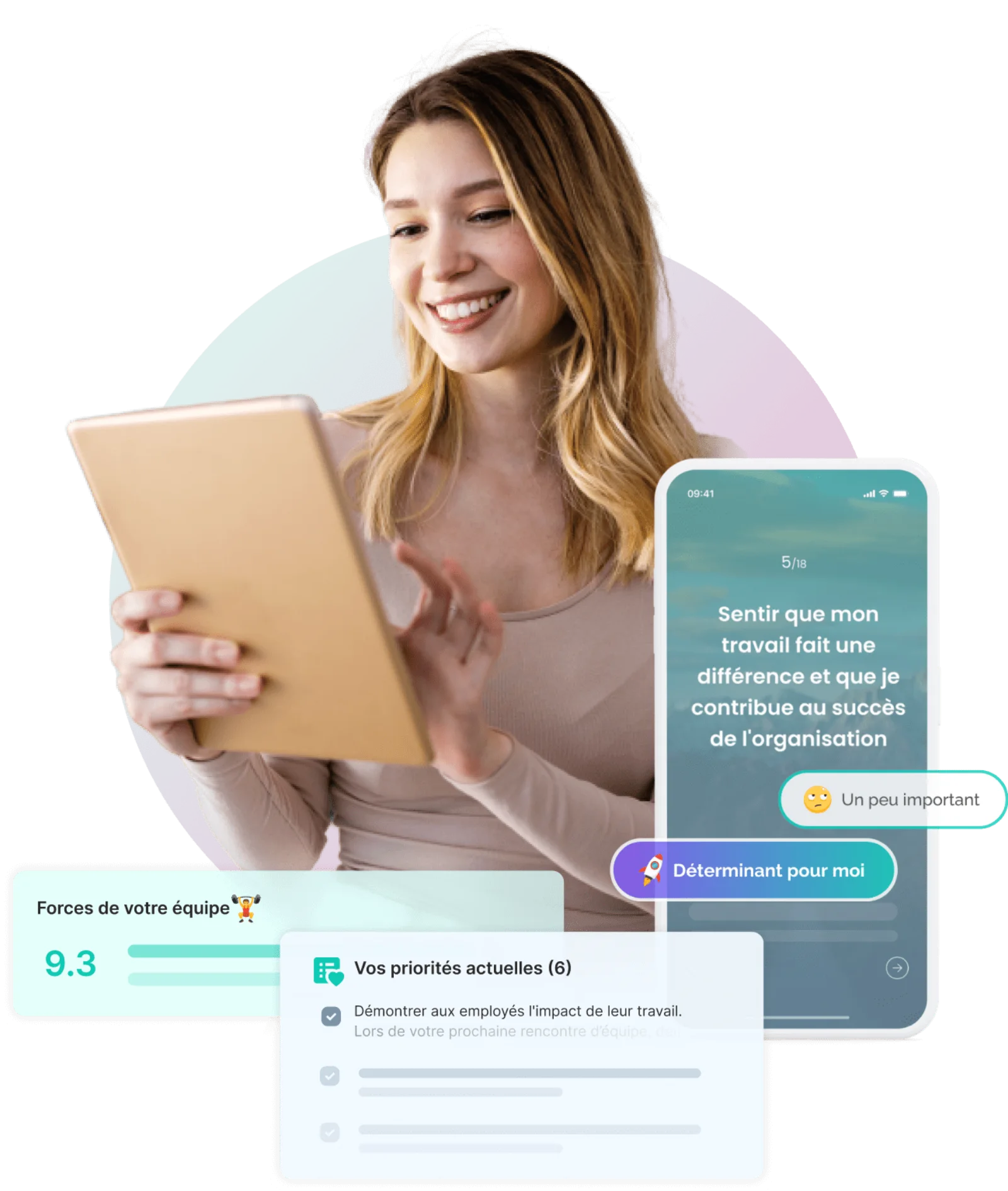
Amélio is an engagement tool that helps you freely express your opinions, ideas and concerns. You can tell your organization what really matters to you and have a concrete impact!

We understand that the key to high-impact change lies in expressing your honest opinions. That's why your answers are always confidential, without exception. No one can see what you answered individually (not management, not HR), so you can express yourself freely and without fear.
The higher the participation, the more faithful the picture is to your realities and the better targeted the actions. Talk about it with your colleagues: it's together that we can bring out what really matters to everyone.
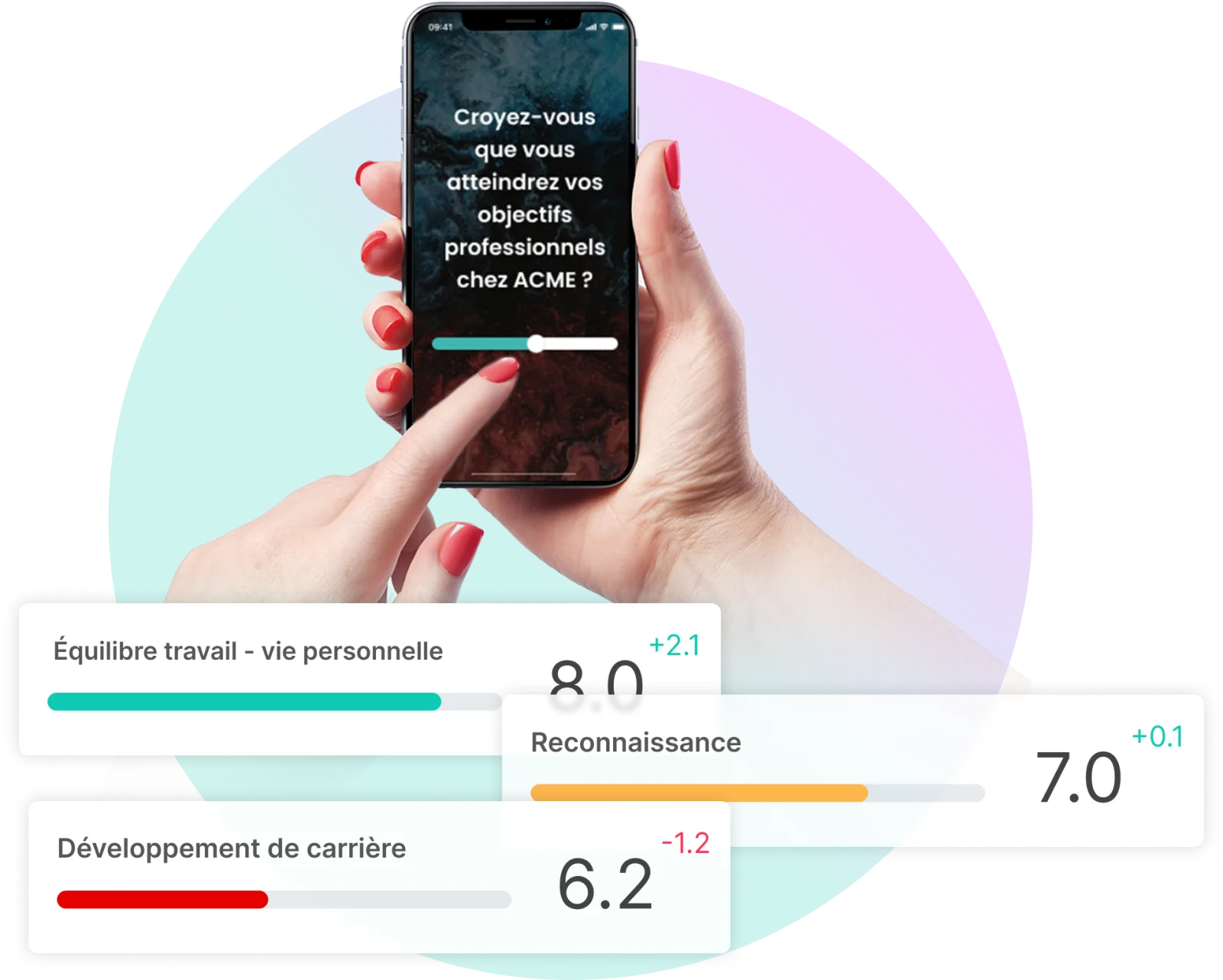
You can leave comments, but how can you make sure your comments have the greatest possible impact? Formulating your comments constructively and proposing solutions is the best way to be heard!
If your organization uses Amélio, it's because it wants your active participation, but above all it is committed to getting involved with you in return! Every organization plans various strategies for reporting results back to employees, to show clear links between your answers and the actions that will be taken.
When in doubt, don't hesitate to contact your organization's management or human resources to get answers to your questions or an update on how the process is evolving.
How do the surveys work?
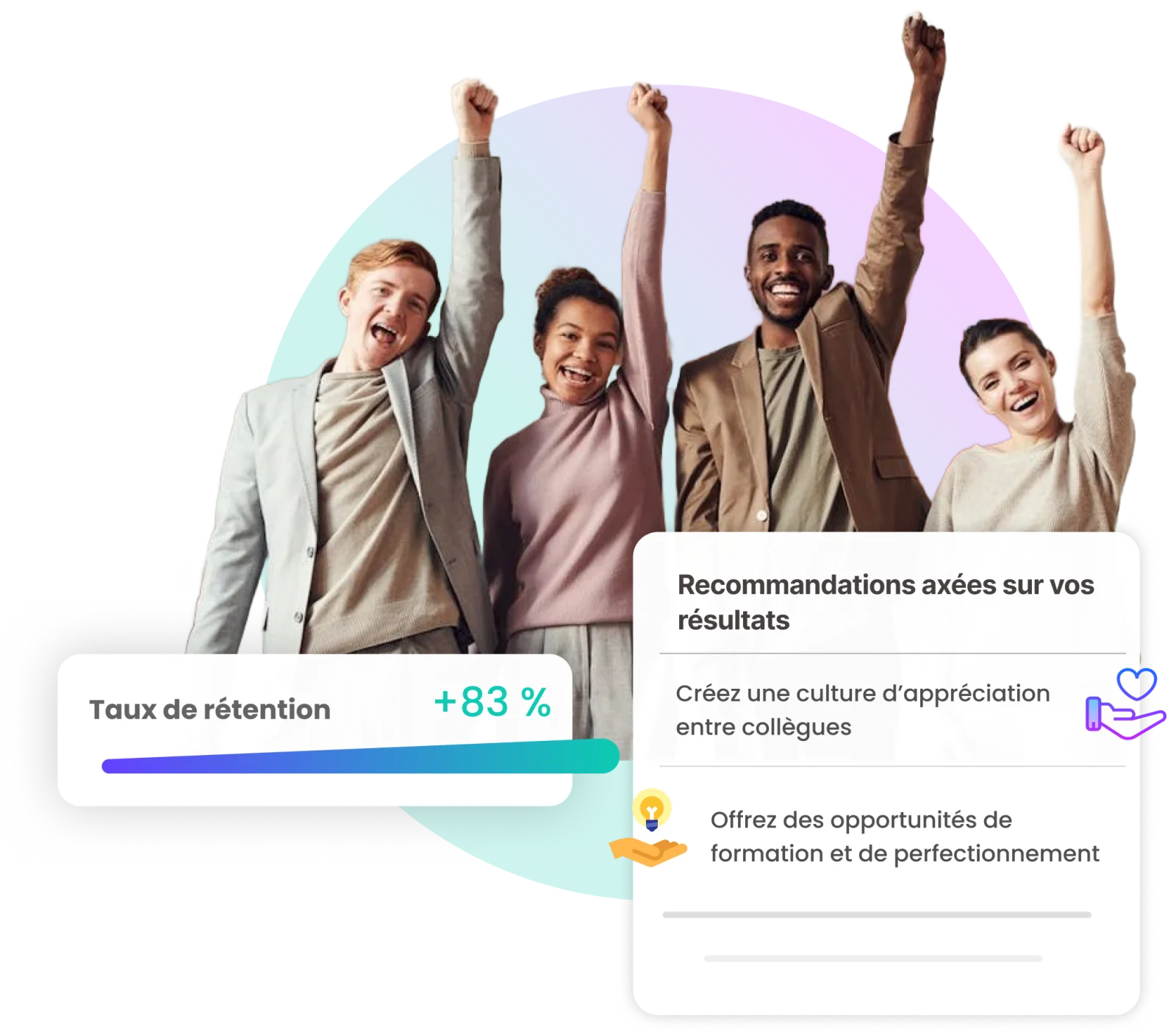
Amélio is a solution designed to turn survey results into concrete actions that benefit everyone. The tool doesn't just collect your answers: it supports HR teams and managers every step of the way:
· Simple, intuitive analyses to quickly understand what really matters to employees and prioritize those elements;
· Suggestions for concrete action plans to encourage good management practices;
· Ready-to-use PowerPoint presentations, tailored to the results, to make sharing and transparency with teams easier;
· And much more…
In short, we don't run a survey for the sake of running a survey: we make sure your comments lead to discussions, decisions and concrete improvements.
It allows continuous monitoring of changes and progress. Your organization can then adjust course if priorities change, or dig deeper into a topic if it remains critical despite the improvements put in place.
If you're unsure, don't hesitate to ask your employer about the purpose of the surveys and the various initiatives related to Amélio. This will help you better understand the added value and motivate you to participate. Who knows, your questions or feedback might even help your employer fine-tune the survey process to your organizational reality!
Absolutely! If you answered by email, text message or user code, your answers are pre-saved. Just make sure to click the button to submit your answers at the very end once the survey is complete.
If the survey your organization launched is still open, and you answered by email, text message or user code, it is possible to reopen your own survey so you can change your answers. To do so, contact the person responsible for managing Amélio surveys in your organization. If you prefer to proceed anonymously, you can also reach Amélio support directly ([email protected]).
The ideal is to formulate comments that not only express your opinion, but steer it toward action. The goal is to help better understand the results and move forward collectively. To do this, explain your needs and possible solutions as clearly as possible. It's the best way to help your organization focus on actions aligned with your reality.
It's perfectly normal not to always know how to solve a situation. Adding a comment still helps add nuance to the results and can open the door to collective reflection. For example: "I've noticed more tension in the team lately… I don't know exactly how to fix it, but I think we should act before it gets worse."
Every organization that uses Amélio appoints an internal person who leads the management of surveys and the various modules, if applicable. It's usually a member of the HR team or management. Don't hesitate to contact them directly if you have questions or need assistance related to Amélio.
It's normal to have doubts when it comes to confidentiality. That's why we're here to clear up any concerns and answer your questions with complete transparency. The confidentiality of your answers is our number one priority.
False: Survey results are aggregated anonymously. This guarantees that your answers remain confidential and cannot be linked to specific individuals. The platform also has a confidentiality threshold of 5 respondents, ensuring that the results of any group of fewer than 5 respondents are not accessible, even to account administrators.
False: Managers do not have access to individual answers. Reports are presented globally, allowing management teams to understand general trends without identifying specific employees. Concretely, if your team has fewer than 5 employees, your manager will not have access to the results. If there are 5 of you, every one of you must have answered for results to be available. In other words, the confidentiality threshold is 5 survey respondents, and your manager will see an overall score for each question, combining all your answers.
Finally, access to results for managers is not granted automatically; it's your organization that makes that decision. To find out who has access to the results, we recommend contacting management or human resources.
False: The surveys are structured to guarantee anonymity, and Amélio never reveals the identity linked to participants' answers. We invite you not to disclose identifying information in your comments (e.g. "I'm the only woman on my team" or "I'm the only person responsible for onboarding the new employee", etc.). We also count on your goodwill to write constructive comments that will then benefit your organization's continuous improvement.
False: Survey answers are anonymous, subjective and individually unverifiable. They therefore do not constitute a legal basis for dismissal, which must rest on a clear cause and follow the steps set out by labour law and your internal processes. The surveys assess your perceptions of the employee experience within your team and the organization. If they reveal concerning situations, your employer could conduct an internal investigation to act fairly and factually.
True: Although participation in the surveys is entirely voluntary, we want to highlight how significant it is. Your contribution plays an essential role in the continuous improvement of your work environment by reflecting the diverse opinions of the whole team. We warmly encourage you to participate, because your voice counts and helps positively shape your professional community.
Engagement isn't just being motivated: it's wanting to get involved, to collaborate, to stay, and to contribute to the success of the team and the organization. And that is something you build.

To fully understand what influences your experience at work, Amélio offers surveys that assess 12 major factors and 40 sub-factors, such as recognition, feedback, autonomy, workload, and many more. The goal: leave nothing in the blind spot and make sure we talk about the real things.
We want to go beyond general impressions. We want to understand what you actually experience and what matters to you.

That's why we take a moment to explain a few key concepts, simply and concretely. Understanding them well will allow you to answer the various statements accurately and, as a result, ensure your organization interprets them correctly.
A few important concepts to know 👇Feeling seen, appreciated and valued for what you do and what you bring. It can come from a manager, a colleague or the team. Recognition is one of the most powerful levers of engagement; we can't afford to overlook it!Example: "My manager thanked me for helping a colleague, and it really motivated me."
Receiving clear, constructive and respectful comments on our work: what's going well, what can be improved, and how to progress. When given with respect and kindness, it becomes a powerful lever to learn, progress with confidence and feel recognized for your efforts.Example: "After a project, my manager always takes the time to tell me what I did well and what I can improve."
For this feedback climate to take hold durably, it is essential to guarantee a framework of safety and anonymity. That's why Amélio rigorously enforces a confidentiality rule of 5 respondents, ensuring that the results of any group of fewer than 5 respondents are not accessible, even to account administrators.
It's clearly understanding what's expected of you in your position: your responsibilities, your priorities and the objectives to reach. When roles are clear, you know where to focus your efforts and you avoid grey areas or misunderstandings. It reduces stress and improves collaboration.Example: "I know what I need to focus on each week, and who to turn to when I have a doubt."
It's having the freedom (and the trust) needed to organize your work, make certain decisions and propose ideas. Autonomy doesn't mean being left to fend for yourself, but rather feeling you have the leeway to do things your way. It fosters engagement and a sense of competence.Example: "My manager trusts me to manage my schedule and my priorities."
It's the general atmosphere and the quality of relationships within the team: do we trust each other, do we listen to each other, do we help each other? A good team climate fosters collaboration, reduces tension and makes day-to-day work more pleasant.Example: "Even when it's stressful, we help each other out and keep a good mood in the team."
It's having access to opportunities for learning, progression or taking on responsibilities. Development can come through training, stimulating projects, mentoring or feedback. It's what allows us to grow in our role and to see a future for ourselves.Example: "I was offered training to better manage conflicts, and it's already helping me in my role."
It's feeling accepted, respected and fully integrated in your team and in the organization. When you have a strong sense of belonging, you want to contribute, to stay, and you feel good where you are. It's an essential factor for well-being and retention.Example: "Even working remotely, I feel like I'm part of the team and that my opinion counts."
It's feeling treated fairly, regardless of your role, seniority or personal characteristics. Fairness doesn't mean giving exactly the same thing to everyone, but making sure everyone has the same opportunities, the same respect and the same possibilities.Example: "Advancement opportunities are offered to everyone, not just those who get noticed the most."
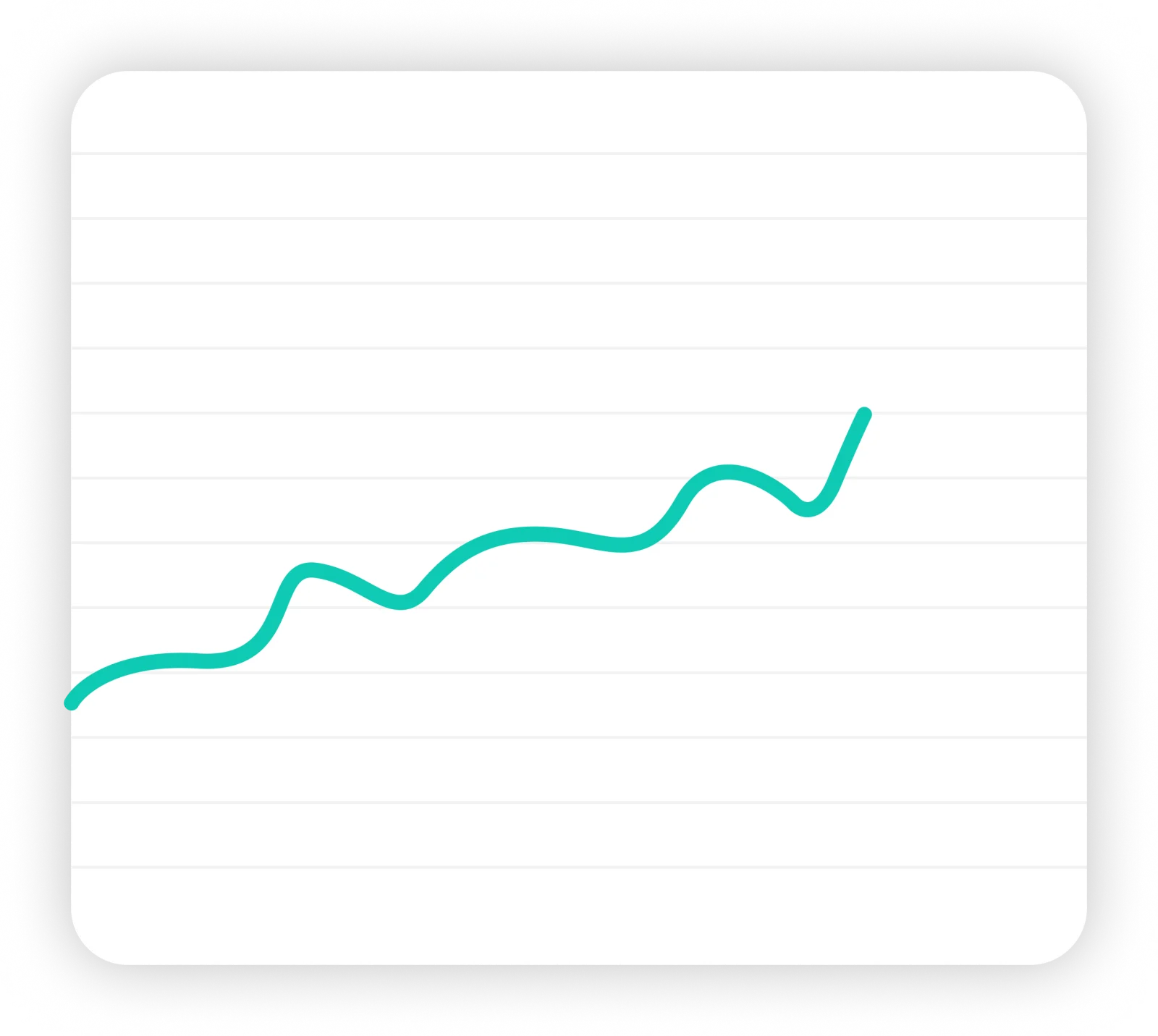
Engagement isn't an overnight revolution. It's a gradual, linear and above all collective process. Sometimes there are big changes, sometimes calmer periods… and that's perfectly normal. What counts is the accumulation of small improvements at the right time, at the right pace.
Every comment, every answer helps share needs rather than evaluate people. For example, naming what works well with your manager (or what you'd like more of) helps understand how to adjust course. And that's true for every topic covered: the idea is to collaborate in finding solutions, together.

Sporadic, surface-level improvements, followed by long stretches of inaction.

Lasting improvements, driven by small, consistent actions well aligned thanks to employee feedback.